"Sometimes, rarely I must admit, I take an interest in certain young people who practice and teach martial arts.
Originally, I was supposed to interview Fabien Latouille, his father, who is a renowned expert and has met numerous personalities of Chinese martial arts since the 1980s, in France and abroad.
But I thought, being busy with time and the classes I teach, after meeting Maoni, the son, at a Tuishou competition, why not interview him, someone who has lived Kung Fu since childhood and who now teaches. This could be interesting, and it would provide a fresh perspective on current Kung Fu, seen through the eyes of a young 20-year-old expert.
And I do not regret this decision, because Maoni allows us to understand that the various Kung Fu styles, when properly transmitted and practiced, are magnificent educational tools that can help develop attentive, open-minded, passionate, and balanced character traits." - Sebastien Zacharie, Kung-fu teacher
You are young, Maoni, born in 2004. I read that you started martial arts at the age of 2, is that true? Were your parents, who traveled a lot, your first teachers?
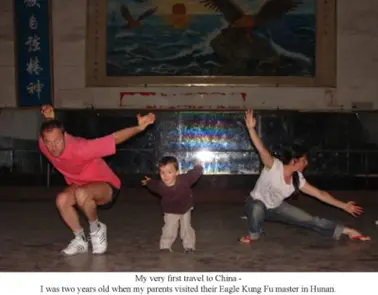
Yes, I’m 20, the age of all possibilities! Indeed, my parents, Fabien and Saline Latouille, are passionate practitioners and teachers of martial arts, and I learned to hold the "horse stance" as soon as I could stand. They traveled a lot to meet masters but also to make documentaries. At the time, I did not realize the luck I had to see these extraordinary places and people, but they still sometimes remember me today.
Kung Fu lessons took place a little every day, until I could join adult classes at the age of 9. Around 15, I started teaching children as an assistant, and then also with adults. This year, I passed a BPJEPS diploma as a sports teacher, and I can now teach Kung Fu and Tai Chi to all audiences, as well as other activities : aerobics, parkour, archery...
👇 me training in China with my parents, for the very first time at 2 years old
Your father, Fabien, and your mother, Saline, as filmmakers, choreographers, and performers, trained and befriended many masters during their travels in the United States and Asia. Can you tell us which ones you are closest to in transmitting the styles you teach at "Perle et Dragons"?
My father often says that in Kung Fu, there are no ranks. In China, students are all Kung Fu "brothers" or "sisters." In the 1990s, masters were still very closed off to foreigners. My father had to make numerous unsuccessful trips before the masters recognized his efforts and finally accepted him as a disciple.
Some masters welcomed us into their homes during our stay, and over time, we truly became part of their family. This is the case for Liu Li Hong, a master of the Eagle style who lives in Hunan and is a true star in cinema and performance in China.
There is also Yew Ching Wong and his son Ray, masters of Hung Gar and representatives of Lam Jo, who live in San Francisco, as well as Fong Ha, master of Tai Chi and Yi Quan, now deceased, who lived in Berkeley.
These are the three masters we are closest to, although my parents also practiced Praying Mantis with Lee Kam Wing, Wing Chun with Wan Kam Leung, Choy Lee Fut with Doc Fai Wong, and Bagua with To Yu — personalities in martial arts who also became very good friends.
👇 Master Liu Li Hong (left) and Master Zhu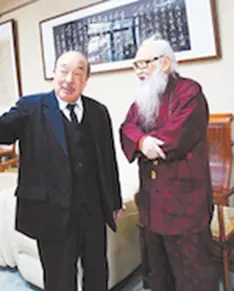
Do you have any anecdotes with certain masters during your childhood training?
I grew up with family instruction, meaning I was homeschooled due to my parents’ frequent travels. We did everything together: outings, games, cleaning, cooking, homework, and Kung Fu, of course, which I could not escape!
For a long time, I was reluctant to train outdoors before breakfast. I much preferred playing Pokémon. But over time, it became easier and easier. I started to enjoy it and even practiced on my own. Gradually, Kung Fu took as much, then more space in my life than Pokémon — and that says a lot (laughs).
Liu Li Hong, in China, had a grandson a few years older than me. Even today, I don’t know his real name, because I always called him "Gege," which means "big brother" in Chinese. He trained very hard, and at six years old, he was already a champion in his style.
How many styles do you teach?
I like to say that I am a practitioner of Kung Fu as a whole, without distinction of styles. I absolutely love all its aspects, traditional and modern. I am open to all opportunities.
However, I only teach the styles I have practiced for a long time and know best, so Hung Gar, Praying Mantis, and Yang Tai Chi, although I incorporate elements of my other practices into my classes.
Have you kept in touch with all these Asian masters?
Some only knew me as a child; others are deceased. But I gradually reconnected with some, notably Y.C. Wong and Ray, his son, whom I visited and trained with last year in America. This year, I hope to have the chance to visit Liu Li Hong in China, as our last meeting was more than ten years ago. I also try to meet new masters by participating in events and competitions in France and elsewhere.
I saw you at your first Tuishou competition. I know your father learned Yi Quan with a renowned master in Hong Kong, then in the USA, named Fong Ha. Did he teach you personally? Do you have any anecdotes from your father about this?
Fong Ha learned Tai Chi from direct students of Yang Cheng Fu and Yi Quan from Han Xing Yuan.
An interesting anecdote dates back to 2008. My parents were returning from a trip to Hong Kong where they met Lam Jo, a celebrity in the Hung Gar world, who was already 98 years old but continued practicing Kung Fu every day with surprising vigor. His handshake was so powerful that my parents have an unforgettable memory of it.
When they spoke about it to Fong Ha, he replied, “Well, I’m only 71, but my handshake is very gentle,” showing that internal strength can also be expressed with softness and flexibility.
Master Fong Ha is no longer with us today, but his martial skills and the way he embodied Tai Chi principles in daily life remain a model for everyone who knew him. Today, I have reconnected with some of his students in California, whom I visited during my stay with Y.C. Wong.
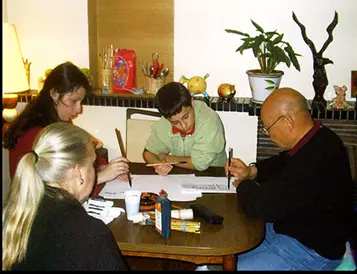
👇 Master Fong Ha introducing the family to calligraphy
You are also in the transmission of Master Y.C. Wong, who immigrated to Hong Kong and then to San Francisco. He taught you Bagua, Hung Gar, and Tai Chi, I believe. Did he also teach you Tuishou?
Exactly. Y.C. Wong and his son Ray Wong teach Hung Gar of the Wong Fei Hung lineage, but also a forgotten Tai Chi style: Kuan Ping Yang. I had the opportunity there to learn forms and practice many exercises specific to these two styles, sometimes resembling sticky hands, both empty-handed and with weapons (sword, staff). But it was not specifically Tuishou.
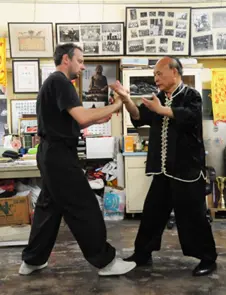
👇 Master Y.C. Wong and Fabien Latouille in 1999
In 2024, you competed in Sanda for the first time. What did you take away from that experience?
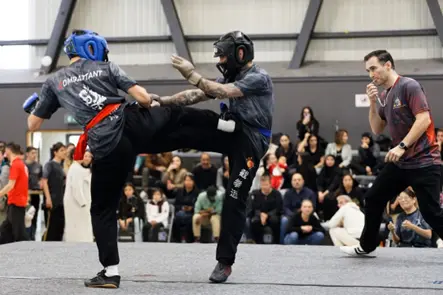
Ah yes! It was a Full Contact Interstyle open, meaning there were Kung Fu practitioners, as well as boxing, Muay Thai, and other styles. It was a bit scary, but at the same time, I was eager to see how it would go.
My first fight went reasonably well, but due to stress, I stuck to a guard and very basic movements, a bit like Kickboxing, so without too many results, as that is not what I train for.
For the second fight, I was already more comfortable, adopting a typical Kung Fu guard from the start, which helped me feel in my element, and I was better able to place principles and techniques effectively. I think it was a positive experience.
It gave me an idea of how to apply my Kung Fu against an unknown opponent determined not to give in. That said, and with all humility, I did not use my “full potential,” and I don’t think I could ever do so in competition, as I cannot bring all my force into a technique at the risk of injuring my opponent, just to win a medal.
So I don’t go to win, but to train and place techniques, even if I don’t push them to the limit.
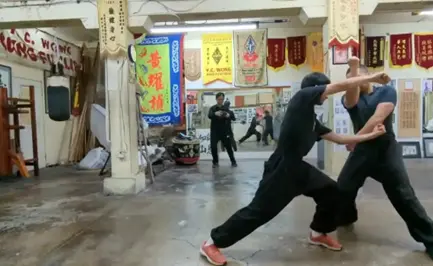
👇 Rhône's All styles Open, organised by the Shaolin Wing Chun school in Lyon
Have you ever had to defend yourself in the street?
Not in the usual sense. I have never had to fight to get out, but that does not mean I never used Kung Fu to defend myself. Principles of posture, gaze, reflexes, and verbal de-escalation have always been enough for me to get out unscathed. I consider that the greatest victory.
Your family and you place a lot of importance on transmission, pedagogy, and culture. Do you think traditional Chinese martial arts can adapt to modern life, where everything goes fast?
In modern society, we are increasingly used to getting everything immediately. The slightest desire can be satisfied in a few clicks, and often for free. But Kung Fu is not easy. It takes time, a lot of perseverance, endurance over many years.
Reviewing the basics, again and again. Falling constantly, getting up each time. We are often tempted to give up and move on. But if we persist, if we continue despite difficulties, we eventually feel solid, rooted like trees, yet free as the air.
This cannot be obtained except through time and effort. Working on posture and attitude strengthens both the legs and the mind. Techniques serve both to deflect physical attacks and handle dangerous situations. Kung Fu teaches to stay upright, proud, and to believe in one’s convictions (Yang). And also to be flexible, calm, to adapt to problems rather than confront them (Yin).
We can then pursue our goals by putting the best of our abilities to use, but also, hopefully, inspire those around us to do the same. I sincerely believe that our life depends 10% on what happens to us, and 90% on what we do with it.
What do you wish to transmit to your students?
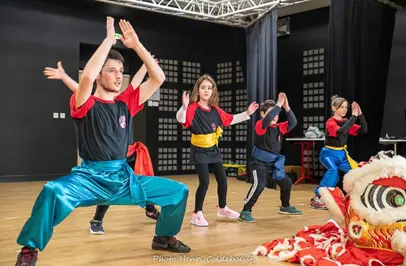
The first and most important lesson I want to teach my students is respect — for themselves and for others. A student who salutes at the beginning and end of class, who knows how to give and receive advice without judging, who believes in their convictions but does not impose them on others, is a very good practitioner, no matter their technical level.
I know you continue to travel and meet masters. Have you become a disciple of a master?
I was fortunate to become very early the disciple of a renowned master in several styles: Fabien Latouille (laughs).
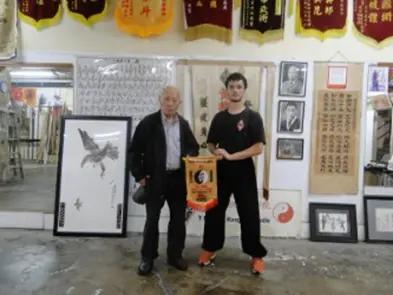
Beyond that, there was a sort of ceremony on my last day in San Francisco where, after performing all the forms I knew, we saluted, and Y.C. Wong gave me a scroll from his school, symbolizing that I was authorized to represent their martial lineage. It touched me deeply. After that, we went to a Chinese restaurant together with very senior students, before I left for the airport.
👇 Maoni with Master Y.C. Wong
You were fortunate to have expert parents passionate about Chinese martial arts. One could say you "fell into it as a child." What do you take away from their transmission?
Like Obelix with magic potion, martial arts are an integral part of my life. I am a "Kung Fu Nerd," because everything I do, from the moment I wake up to the moment I go to bed, is Kung Fu. I practice, learn, read, watch, teach, research, write, and make videos about it. It’s my way of life, and I try to share this passion and its benefits with as many people as possible — locally, with classes, but also online, to counterbalance the general reputation of traditional martial arts on the internet.
That’s why I launched on social media (@maonilatouille and @kungfuhorizon on Facebook, Instagram, and TikTok) and created my website: www.kungfuhorizon.com
Thank you very much for your interest and questions, Sébastien, and I look forward to seeing you at a next event!
My interview by Sebastien Zacharie